
Jane Wenham
The woman who ended the witch-craze

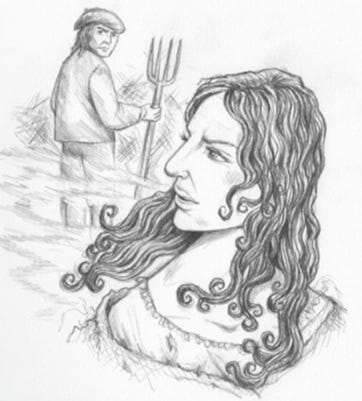
When you write the history of the last hundred years, there’s always a source if you just dig deep enough. People leave traces, them or their friends, there’s such an abundance of written material. Go back further, though, and it’s different. There are people who held Archimedes’ lever in their hand and used it to change the world, left no trace in the archives. As a historian, you look for them, search everywhere you can for evidence of them speaking in their own words. You look and find nothing, what endures is silence.
Jane Wenham was one of those people who did indeed turn the world upside down. A poor woman, middle-aged, she lived in Walkern in Hertfordshire. In 1700, 800 people lived there. In March 1712, a court found Wenham guilty of witchcraft and sentenced her to death. The court petitioned the Queen for her sentence to be reprieved. Wenham’s pardon marks the end of 120 years of witch-hunting in Britain. James I, Matthew Hopkins, ducking stools, thumb screws, the needles the witchfinders used to search for moles or scars, all that grisly equipment of social harm – all lost their purpose, in an instant. For another 20 years, there were no witch trials; if the convicted would be pardoned, what was the point? In 1735, the Witchcraft Act repealed all the laws by which doing magic had been a criminal offence – the 1542 law making witchcraft an offence, the 1563 Act prohibiting the conjuring of spirits, the 1604 legislation making capital punishment the only sentence available for summoning an evil spirit.
Our cliches about the past make the early modern period seem a time of ignorance and superstition, when anyone was willing to fall for impossible claims. We know the name of King James I’s book Daemonologie, we assume that when he became King of England his idea of witches as beings of immense magical power was universally accepted. But even in the 1590s, sceptical pamphlets were circulating – Daemonologie was written to refute the likes of the Dutch physician Johann Weyer or the English Puritan, Reginald Scot. Already, James’s name was circulating as a potential successor to Elizabeth; part of the case against was that he was unreliable, credulous, likely to be a bad King he even believed in witches. James complained of Weyer and Scot’s “damnable opinions” that there was no such “thing as witchcraft”. For a century the sceptics were silenced; by the early eighteenth century, their voice was a clamour. Wenham’s case helped to shape that abolitionist majority.
The events of Jane Wenham’s prosecution were little different from other witchcraft trials. They began, as so many prosecutions did, in the household. The case began in the home of a clergyman Godfrey Gardiner and his wife Deborah. Their young servant Anne Thorne had recently dislocated her knee and was sat alone in the kitchen. Walking into that room, the Gardiners found Thorne stripped inexplicably to her undergarments. Thorne then ran out of the house, returning with twigs bundled in her apron. Mrs Gardiner saw a rationality in Thorne’s otherwise incomprehensible behaviour. Obviously, a witch must have possessed her.
Gardiner said they should summon the witch, which could be done (everyone knew) by burning in a fire objects cursed with the witch’s dark magic. She took Thorne’s twigs and thrust them into the flames. As she did, a figure knocked at their door, Jane Wenham. The bad timing was not all that told against Wenham. Everything else suggested that she was obviously the malefactor, being poor, elderly and already the subject of gossip.
Wenham had come under suspicion after she asked Matthew Gilston, the servant of a rich farmer, for straw. He refused, after which various of Gilston’s masters’ horses and cattle died. Gilston confronted Wenham, calling her a witch. She approached the local magistrate, seeking compensation for slander. He referred the case to the priest, the same Reverend Gardiner who employed Anne Thorne. Gardiner had fined Gilston the modest sum of a shilling. Wenham then made the mistake of saying that she was displeased with his decision, “If she could not have Justice here, she would have it elsewhere.” Where was this somewhere else? She would not say. Gardiner, annoyed at having his justice questioned by an insolent villager, insisted that Wenham’s words had been a confession of her own guilt. No possible construction could be put on them other than that she was intending to appeal to Satan to intervene.
By choosing to knock on Gardiner’s door – at the very moment that his wife was looking for a witch to blame – Wenham condemned herself to trial. In the face of a united front of hostile worthies, Wenham acted calmly. She insisted that she had no magic. She offered to submit to the tests of swimming or searching. She recited the Lord’s Prayer but (the Gardiners claimed) stumbled over the words. Anne Thorne now joined in the accusations, saying she had been visited by cats with Jane Wenham’s face. Other animals of the same species were seen appearing in the village without explanation, calling and crying. Wenham was sent for trial, charged with conversing “familiarly with the Devil in the shape of a cat”.
Sir John Powell was the judge at the trial, which was heard at the assize in Hertford. Wenham maintained her innocence, declaring that she was a “clear woman”. Powell appears to have been sympathetic to the defence. After one witnessed accused Wenham of flying, the judge is supposed to have said that there was no law against that. When Thorne proved her distress by collapsing in a fit, rather than adopting the prosecutor’s suggestion that the case stop and everyone pray for her recovery, the judge remarked, “She will come to herself.”
The jurors reached a guilty verdict and the law obliged the judge to sentence her to death. Powell adjourned the sentence, however, rather than activate it. He sent the verdict to the Crown requesting a pardon, and Wenham was reprieved four months later.
Witchcraft’s Retreat
To understand why Wenham was pardoned, we need to grasp how different blocs of opinion had been shifting in the 50 years since the end of the revolution and the restoration of the monarchy. A useful way to think of how anyone ruled in this period is to imagine society divided into three large blocs of opinion. To keep on ruling, any fraction of the ruling class needed the active support of two out of three of Puritans, Anglicans and Catholics.
During the Civil War itself, the Puritans had tended to believe in witchcraft; one of their number had been the self-appointed Witchfinder Matthew Hopkins. After 1649, however, they turned against the witch-craze. Published in 1669, John Wagstaffe’s The Question of Witchcraft Debated, claimed that the very idea of witchcraft was “absurd”. Lodowicke Muggleton, the former Ranter, published in 1669 A True Interpretation of the Witch of Endor. Its argument was that evil belonged in mind of the sinner. Should a witch believe that they could speak to animals, they were the victims of a vivid imagination. John Webster was a priest in the New Model Army. Working after the restoration of King Charles as a physician, he settled in the Lancashire town of Clitheroe. His 1677 book, The Displaying of Supposed Witchcraft, made a similar case that witchcraft was a fantasy. He wrote that, “A devil within us is more to be feared than a devil without.” He denounced, “The false doctrine of Witchmongers, that make us watch for the Devil where he is not.”
Anglicans did still believe in witchcraft. Their pamphleteers argued that belief in dark magic was an essential part of their faith, without it, people would tend not to believe in anything, not the aristocracy, the church or the King. In 1672, Meric Casaubon published A Treatise Proving Spirits, Witches and Supernatural Operations. The greatest evil Casaubon wrote was “atheism”, which meant “not believing the existence of spiritual essences, whether good, or bad”. Doubting the reality of witches, he wrote, was no different from doubting in angels. Another Anglican Joseph Glanvill published in 1681 Saducismus Triumphatus (Atheism Refuted), arguing that a failure to accept the possibility that witchcraft was real was but the first step towards disbelieving benign authority. “Those that dare not bluntly say ‘there is no God’ content themselves (for a fair step and introduction) to deny there are spirits or witches.”
These arguments were unlikely to appeal to many Catholics. Anglican pamphleteers ignored them, argued for an understanding of the world in which there was no source of evil save for the devil (Catholic cosmology was just busier than that). The idea that witchcraft was needed to prevent everyone becoming an atheist was too narrow thread to sustain a majority belief.
As late as 1712, society was still shaped by the revolution’s defeat. Supporters of the established church and members of the Hertfordshire gentry allied in demanding that Wenham hang; they felt entitled and confident to do so in part because history had vindicated them. She was a Puritan, aged over 70, a member of a generation who had been raised high by Kings Charles’ execution, then thrown low when the monarchy returned. Her allies were people from the same milieu as her, former supporters of the Parliamentary cause and their ideological descendants. They could not win the battle of ideas or transform England into a democracy, but the Puritans could – and did – lead a successful rearguard action on Wenham’s behalf and against the crime of witchcraft, a superstition in which they no longer believed.
From Walkern to England
On the granting of a pardon to Jane Wenham, she was dragged into the long-standing conflict between Anglicans and Puritans. When Anne Thorne was in the Gardiners’ kitchen, the latter were entertaining a young, ambitious, gentleman - Francis Bragge, the grandson of local squire, Sir Henry Chauncy. Bragge was destined for a career in the established church and took the Gardiners’ side. Bragge borrowed from Glanvill the opinion that witchcraft was true and that a belief in it was the base on which stood loyalty to church and throne. Wenham, he said, had lived a life of “idleness and thievery”. The accused woman, Bragge claimed, had been heard often “swearing and cursing”: she had “the character of whore”. While he did not suggest that dissenting opinions were in very case proof of Satanism, Bragge observed that Wenham was a dissenter. He sought to make a nasty joke out of the fact that the accused woman was a Puritan, “a wicked old Witch is of a sudden become a precious Saint.”
Puritans responded. The Protestant Post-Boy published articles in her defence. A fresh pamphlet appeared, The Impossibility of Witchcraft, its author leaning heavily on the arguments of John Wagstaffe. Bragge replied with further pamphlets insisting on Wenham’s guilty. He took part in a heated debate with a sceptical London dyer in an alehouse in Derby.
Six years after her trial, the Reverend Francis Hutchinson approached Wenham. Hutchinson had a Puritan uncle. He felt no compelling bond of loyalty requiring him to back his fellow priests. Hutchinson already had a draft copy of a manuscript criticising beliefs in witchcraft, which he regarded as “the worst corruptions of religion and the greatest perversions of justice”. Now he needed cases to make his book compelling. Wenham agreed to speak to him.
In his eventual narrative of the court proceedings, Hutchinson began by praising Sir John Powell, Wenham’s judge. He called Wenham “pious” and “sober”. He had asked her to speak the Lord’s Prayer and she had had no difficulty in speaking the sacred words, “though with such little errors of expression, as those that cannot read are subject to”.
Hutchinson described how Wenham now lived, “soberly and inoffensively”. He called her a “pious sober woman”. He reminded his readers that Wenham done right in the face of a false accusation. Called a witch by Gilston, she turned to the law for protection. He did something which no commentator had done before, using Wenham’s poverty and marginality in eighteenth century society as an argument to support her innocence. “I verily believe that there is no one that reads this but may think in their own minds, that such a storm as she met with, might have fallen upon then, if it had been their misfortune to have been poor.”
Wenham triumphed because of her own personal obduracy and because of the solidarity given to her by dissenters in her village and by their allies in London. Penal laws introduced after Cromwell’s death excluded dissenters from public office, military posts, even university education. They were a despised and dissident minority. Even as they won the argument over witchcraft, they were suffering losses in other areas of life.
Conventionally, the story of Jane Wenham ends with her vindication at the hands of Hutchinson. Out of her case, her built a claim that all the great witchcraft trials in history had been based, as hers had been, on lies, “The principles that the witch-finders have proceeded upon,” Hutchinson wrote, “are unnatural, contradictory and absurd. If the premise be proved false, who but a madman will believe the conclusion?”
We can imagine Hutchinson, as he sent his book to the printers, fearing laughter and humiliation. He was an Anglican siding with the dissenters, an uncomfortable place to stand. In epochs of King James and King Charles, no-one would have dared to commit these thoughts to paper. Even after he wrote, others continued to make the case that witchcraft must be real – the novelist But Hutchinson’s points were fast becoming the consensus.
When Hutchinson visited Wenham, she had left Walkern, travelling 18 miles to the south and east, to Gilston. Colonel John Plumer had offered her a home on his estate, where she remained until his death in 1719. When Hutchinson met her, she was an old woman. His account of their meeting was brief; at no point does he explain why she agreed to speak with him. She had no reason to give him permission to tell her story and yet she chose to.
The only way to make sense of her contribution is to see it as an act of trust on her part. Others had written about her, filling in their accounts with guesswork making her an object of evil, the Devil’s willing assistant. Hutchinson was offering to put her case in print. Over the years that followed it became ever harder to believe in her, or any of the accused witches’, guilt.
Thanks for reading this piece. This substack is a leisure operation; I write it in my spare time. I have no intention of charging for content: I want to keep everything here free. But if you enjoy my pieces and want to support the writing, buy one of my books. There’s lots of them.
After reading this essay, I was reminded of China Mieville's talk on Hallowe'en at Socialism in Chicago a few years back. You two might have a good time chopping it up... if you haven't already!